EN
EN

Airless Bottle VS Ordinary Lotion Bottle: Which One Fits Your Product?
Choosing the right packaging is an important decision for skincare, beauty, and personal care brands. A cosmetic bottle does more than simply hold a product. It can help protect the formula, control dispensing, improve the user experience, communicate brand positioning, and influence the overall cost of the finished product.
Among the many cosmetic packaging options available today, Airless Bottles and Ordinary Lotion Bottles are two popular choices for creams, lotions, serums, moisturizers, and other skincare products.
At first glance, they may look similar. However, their internal structures, dispensing mechanisms, product protection, and application scenarios can be quite different.
So, should your brand choose an Airless Bottle or an Ordinary Lotion Bottle?
This guide explains the key differences and helps you determine which packaging solution is more suitable for your product.
What Is an Airless Bottle?
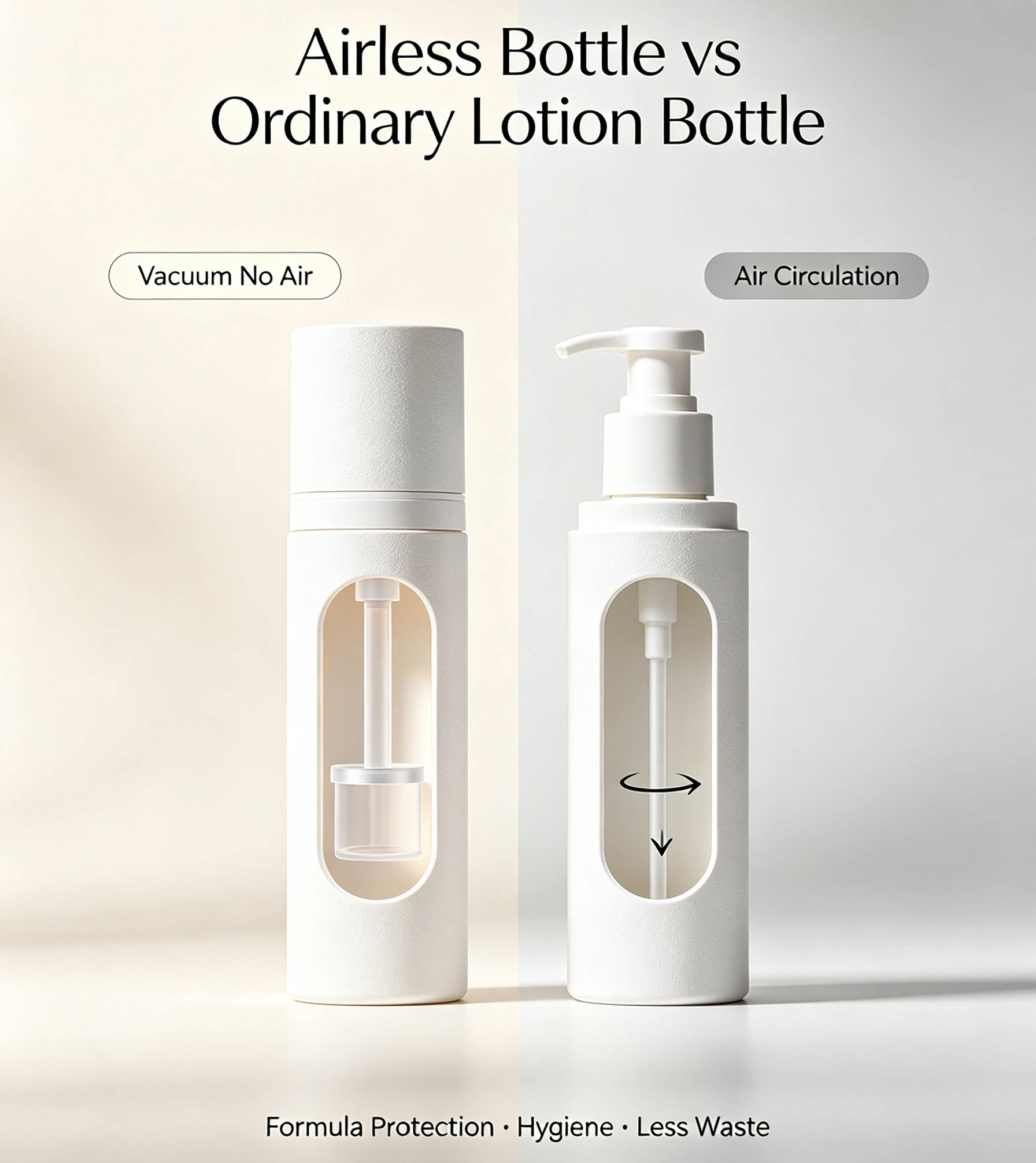
An Airless Bottle is a cosmetic packaging container designed with an airless dispensing system. Unlike traditional lotion bottles that normally use a dip tube, an airless bottle typically uses an internal piston or similar mechanism to move the product toward the dispensing outlet.
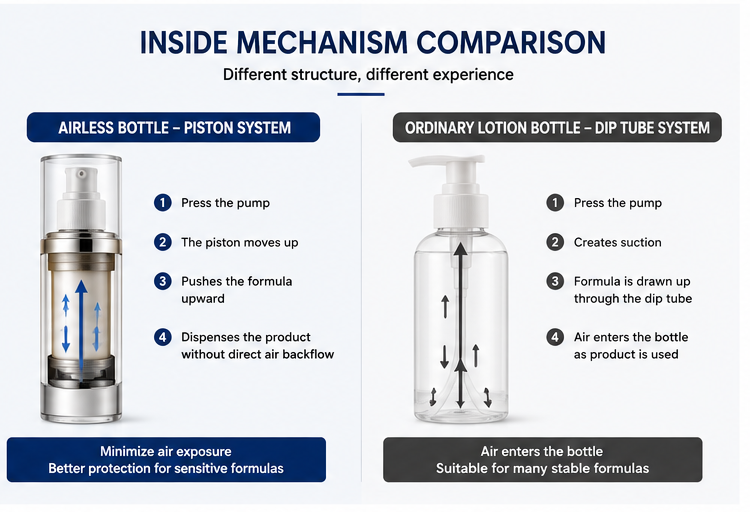
When the consumer presses the pump, the internal mechanism pushes the product upward and dispenses it through the pump.
Because the product is not repeatedly exposed to large amounts of air during normal dispensing, Airless Bottles can be particularly attractive for certain skincare formulations and premium cosmetic products.
Key Benefits of Airless Bottles
Reduced direct air exposure during dispensing
Hygienic and controlled product dispensing
Smooth and convenient application
Efficient product evacuation
Premium and modern appearance
Suitable for many skincare applications
Multiple capacity and decoration options
Suitable for customized cosmetic packaging projects
Airless packaging is especially popular in skincare because many brands want to combine functional product protection with a premium consumer experience.
What Is an Ordinary Lotion Bottle?
An Ordinary Lotion Bottle is a conventional cosmetic bottle commonly equipped with a lotion pump and an internal dip tube.
When the pump is pressed, the pump mechanism creates suction and draws the formulation through the dip tube before dispensing it through the pump head.
This packaging structure has been widely used for many years because it is simple, practical, reliable, and suitable for a wide range of personal care products.
Common Applications of Lotion Bottles
Ordinary Lotion Bottles are commonly used for:
Body lotion
Hand lotion
Facial lotion
Moisturizing lotion
Shampoo
Conditioner
Shower gel
Liquid cleanser
Body care products
Hair care products
For stable formulations and high-volume products, conventional lotion bottles can provide an effective balance between functionality, convenience, and packaging cost.
Airless Bottle VS Ordinary Lotion Bottle: 8 Key Differences
Understanding the differences between these two packaging solutions can help brands make a better packaging decision.
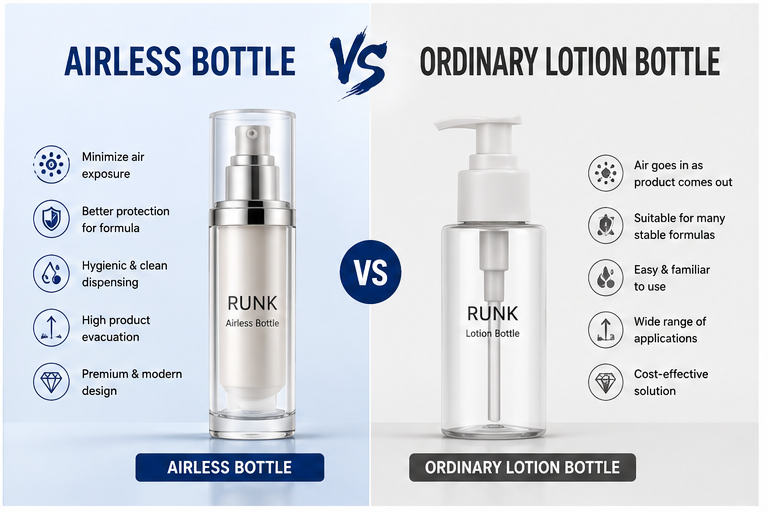
1. Dispensing Mechanism
The most obvious difference is the internal dispensing structure.
An Airless Bottle typically uses an internal piston or airless mechanism. As the product is dispensed, the internal component moves upward and pushes the formulation toward the pump outlet.
An Ordinary Lotion Bottle generally uses a dip tube. The pump draws the formulation upward through the tube.
This difference can influence how the product is dispensed, how much air interacts with the formulation, and how effectively the remaining product can be evacuated.
2. Product Protection
Product protection is one of the major reasons brands consider Airless packaging.
During normal use, Airless Bottles are designed to minimize direct air exposure to the formulation. This can be beneficial for products that are more sensitive to environmental exposure.
Ordinary Lotion Bottles allow air to enter the container as the product volume decreases. For many stable formulations, this structure works very well. However, formulations with greater sensitivity to oxidation or contamination may require more careful packaging consideration.
It is important to note that packaging alone does not determine product shelf life. Formula stability, preservatives, filling conditions, storage conditions, and compatibility testing are also important factors.
3. Product Evacuation
Another important consideration is how much product can be effectively dispensed from the container.
The internal piston of an Airless Bottle moves upward as the product is used. This design helps push the remaining formulation toward the dispensing outlet.
With a conventional lotion bottle, the dip tube draws product upward from the bottom of the container. Depending on the formulation viscosity, bottle geometry, and pump design, some product may remain inside.
For premium skincare products with relatively high product value, efficient product evacuation can be an important advantage.
4. Hygiene and User Experience
Consumers increasingly care about clean and convenient cosmetic packaging.
Airless Bottles can provide a controlled dispensing experience without requiring users to repeatedly open the container and directly contact the formulation.
This can be particularly useful for facial skincare products and premium formulations.
Ordinary Lotion Bottles also provide convenient and hygienic dispensing when used with a properly designed pump. They remain a popular option because consumers are already familiar with this packaging format.
5. Formula Viscosity
The viscosity of the formulation should always be considered before selecting packaging.
Airless packaging can be suitable for many:
Moisturizers
Facial creams
Serums
Emulsions
Anti-aging products
Skincare lotions
Premium cosmetic formulations
Ordinary Lotion Bottles are also suitable for many low-to-medium viscosity formulations, including:
Body lotion
Hand lotion
Shampoo
Conditioner
Shower gel
Facial lotion
Liquid cleanser
However, there is no universal bottle for every formulation. The pump, actuator, dip tube, piston, orifice, bottle structure, and formulation viscosity should be evaluated together.
Packaging compatibility testing is strongly recommended before large-scale production.
6. Packaging Cost
Cost is an important consideration for both new and established cosmetic brands.
Airless Bottles usually have a more sophisticated internal structure and dispensing mechanism. Therefore, their unit cost may be higher than that of standard lotion bottles.
Ordinary Lotion Bottles generally have a simpler construction, making them attractive for brands that need cost-efficient packaging, particularly for large-volume products.
However, packaging cost should not be evaluated based on the bottle alone.
The overall packaging cost can also depend on:
Bottle capacity
Material
Pump type
Cap design
Decoration
Printing method
Surface finishing
Customization
Order quantity
Packaging and shipping requirements
For premium skincare products, the additional investment in Airless packaging may be worthwhile because the packaging itself can contribute to product positioning and perceived value.
7. Brand Positioning
Packaging is also a powerful branding tool.
Airless Bottles often have a sophisticated and modern appearance, making them a good match for:
Premium skincare brands
Professional skincare
Anti-aging products
High-end moisturizers
Minimalist beauty brands
Functional skincare products
Ordinary Lotion Bottles are highly versatile and can also be customized to create a premium appearance.
With customized colors, printing, hot stamping, coatings, labels, and different pump designs, a conventional lotion bottle can be transformed into a distinctive brand packaging solution.
8. Sustainability and Material Selection
Sustainability has become an increasingly important consideration in cosmetic packaging.
When selecting between Airless Bottles and Ordinary Lotion Bottles, brands should consider more than simply the bottle structure.
Important factors include:
Material selection
Recyclability
Use of recycled materials
Number of components
Packaging weight
Product-to-package ratio
Manufacturing processes
Transportation efficiency
End-of-life considerations
Depending on the product design, brands may also explore recycled or alternative material options for certain packaging components.
For brands targeting markets with increasing packaging sustainability requirements, it is important to evaluate the complete packaging system rather than focusing on a single component.
Airless Bottle VS Ordinary Lotion Bottle Comparison
| Feature | Airless Bottle | Ordinary Lotion Bottle |
|---|---|---|
| Dispensing System | Airless piston or similar mechanism | Pump with dip tube |
| Direct Air Exposure | Minimized during dispensing | Generally higher |
| Product Protection | Excellent for suitable formulations | Suitable for many stable formulations |
| Product Evacuation | Generally efficient | Depends on bottle and pump design |
| User Experience | Premium and controlled | Simple and familiar |
| Packaging Structure | More sophisticated | Relatively simple |
| Packaging Cost | Usually higher | Usually more economical |
| Premium Positioning | Excellent | Good with customization |
| Body Care Products | Suitable | Excellent |
| Skincare Products | Excellent | Excellent |
| Shampoo and Conditioner | Possible depending on design | Common choice |
| Customization | Available | Available |
When Should You Choose an Airless Bottle?
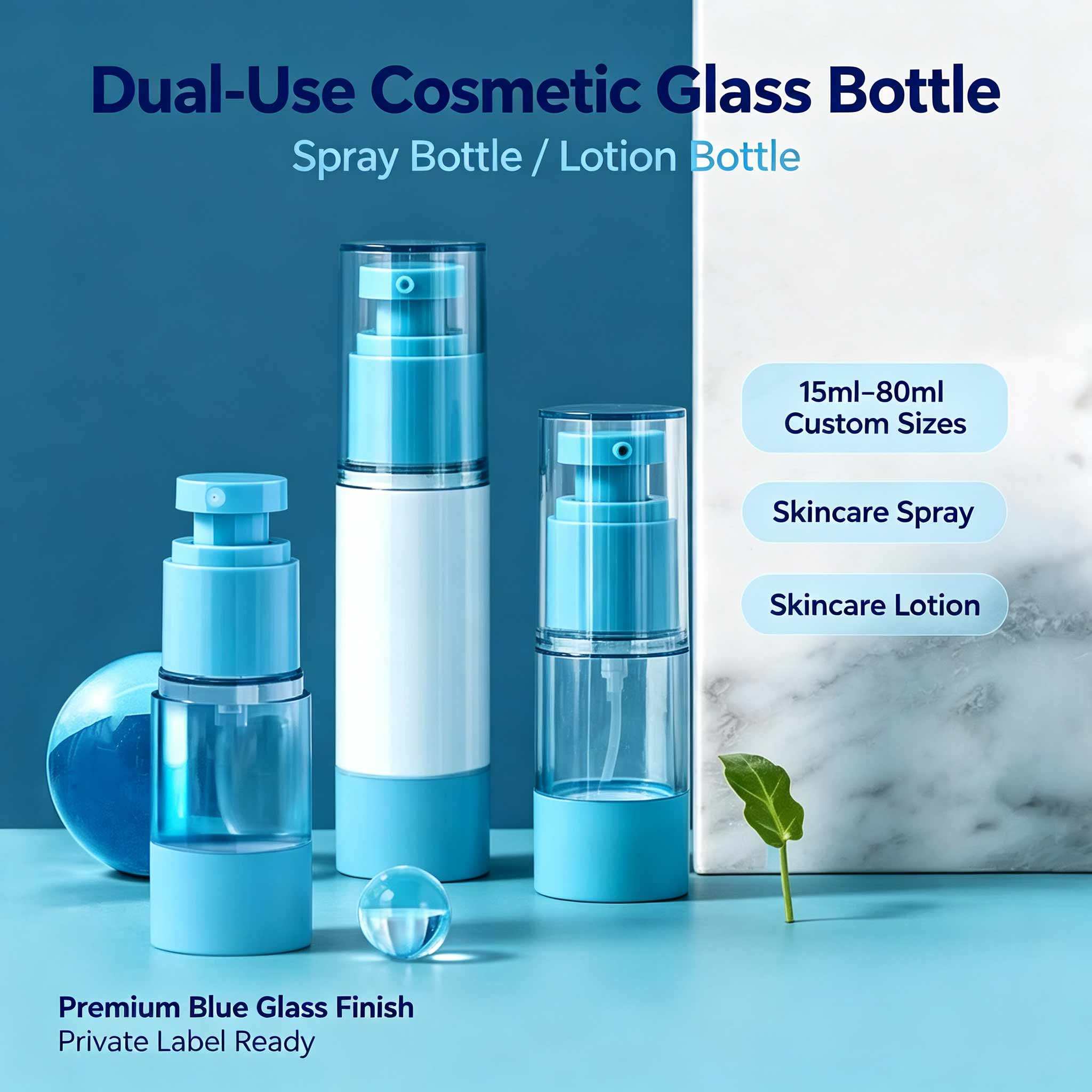
An Airless Bottle may be a suitable option if your product requires:
1. Enhanced Protection From Air Exposure
If your formulation is sensitive to air exposure, an airless dispensing system may be worth considering.
2. Premium Product Positioning
If your brand focuses on premium skincare or professional beauty products, Airless packaging can support a sophisticated brand image.
3. Controlled Dosage
If you want consumers to dispense a consistent amount of product with each pump, an Airless Bottle can be a good option.
4. Efficient Product Use
If minimizing residual product inside the container is important, an airless piston system may provide an advantage.
5. Modern Packaging Design
Airless Bottles can be customized into clean, elegant, and modern packaging designs that work well with contemporary skincare branding.
When Should You Choose an Ordinary Lotion Bottle?
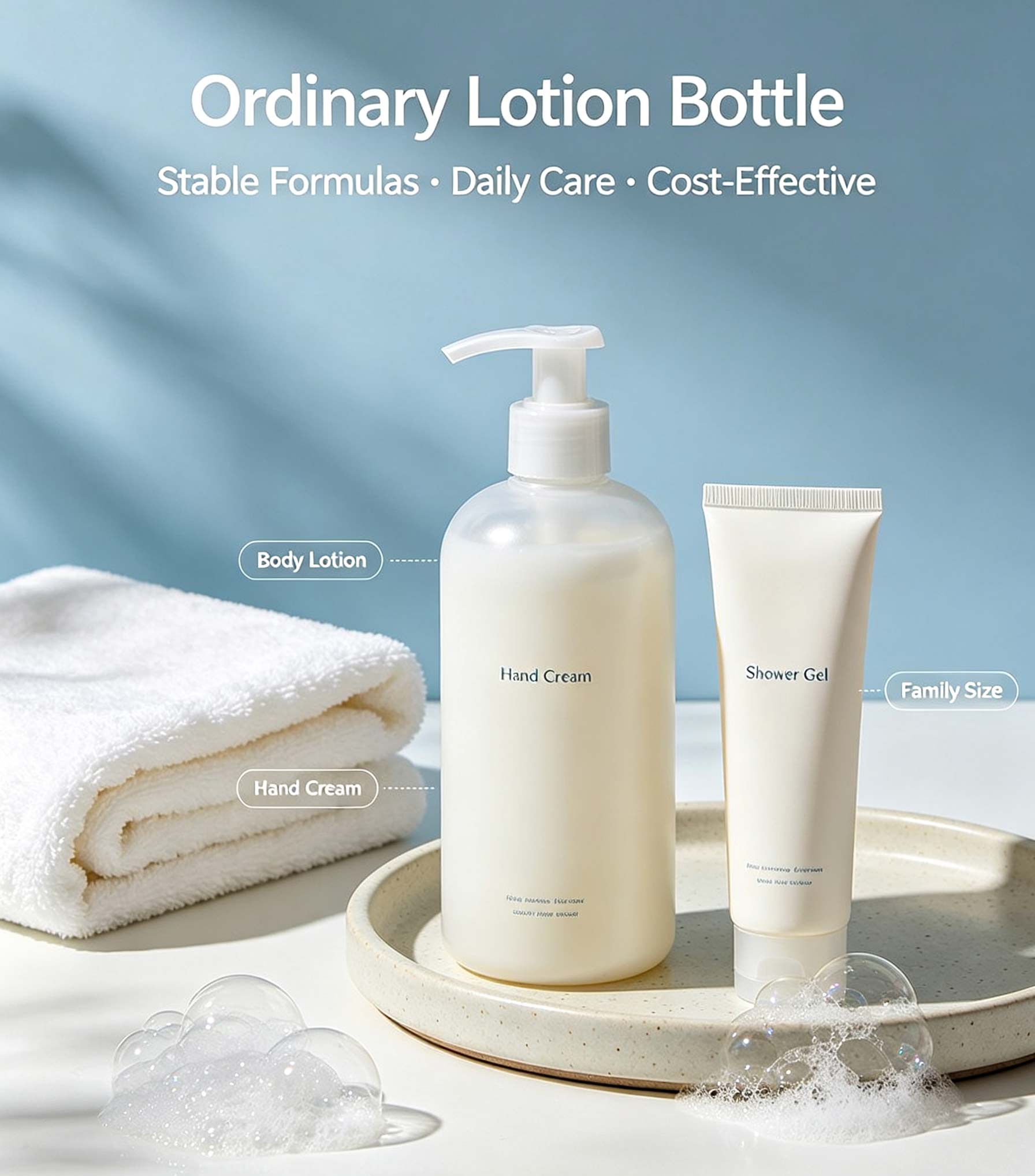
An Ordinary Lotion Bottle may be the better option when:
1. Your Formula Is Stable
For many stable lotions and personal care formulations, a conventional lotion bottle can provide sufficient packaging performance.
2. Cost Efficiency Is Important
If your product targets the mass market or requires large production volumes, a conventional lotion bottle may offer a more competitive packaging cost.
3. You Need a Familiar Packaging Format
Consumers are already familiar with lotion pump bottles, making them easy to understand and use.
4. Your Product Is Used Frequently
Body lotion, shampoo, conditioner, shower gel, and other everyday products can benefit from the simple and convenient design of a standard pump bottle.
5. You Want Flexible Customization
Ordinary lotion bottles can be customized with different colors, capacities, pumps, caps, printing, and surface finishes.
How to Choose the Right Cosmetic Bottle for Your Product
Before making a final decision, cosmetic brands should consider the following factors.
Product Formula
What is the formulation?
Is it a lotion, cream, serum, emulsion, gel, or another type of cosmetic product?
Different formulations may require different dispensing systems.
Viscosity
Is your formulation thin, medium, or thick?
The viscosity can directly influence pump performance and dispensing consistency.
Product Sensitivity
Does the formula have a greater sensitivity to air, oxidation, or contamination?
If so, an Airless Bottle may deserve consideration.
Target Market
Are you selling a mass-market body lotion or a premium facial serum?
The packaging should match the expectations of your target customers.
Budget
Determine your target packaging cost before selecting the final structure.
Brand Image
Your packaging should visually communicate your brand's identity.
Minimalist, luxury, natural, professional, and mass-market brands may all require different packaging styles.
Required Capacity
Common cosmetic bottle capacities can range from small travel sizes to larger body care packaging.
Choosing the right capacity can improve convenience and influence the overall appearance of the product.
Custom Cosmetic Bottle Solutions From Runk
At Runk, we understand that every beauty brand has different packaging requirements.
As a cosmetic packaging supplier, we provide customized packaging solutions for skincare, beauty, body care, hair care, and other personal care products.
Our packaging capabilities can support different requirements, including:
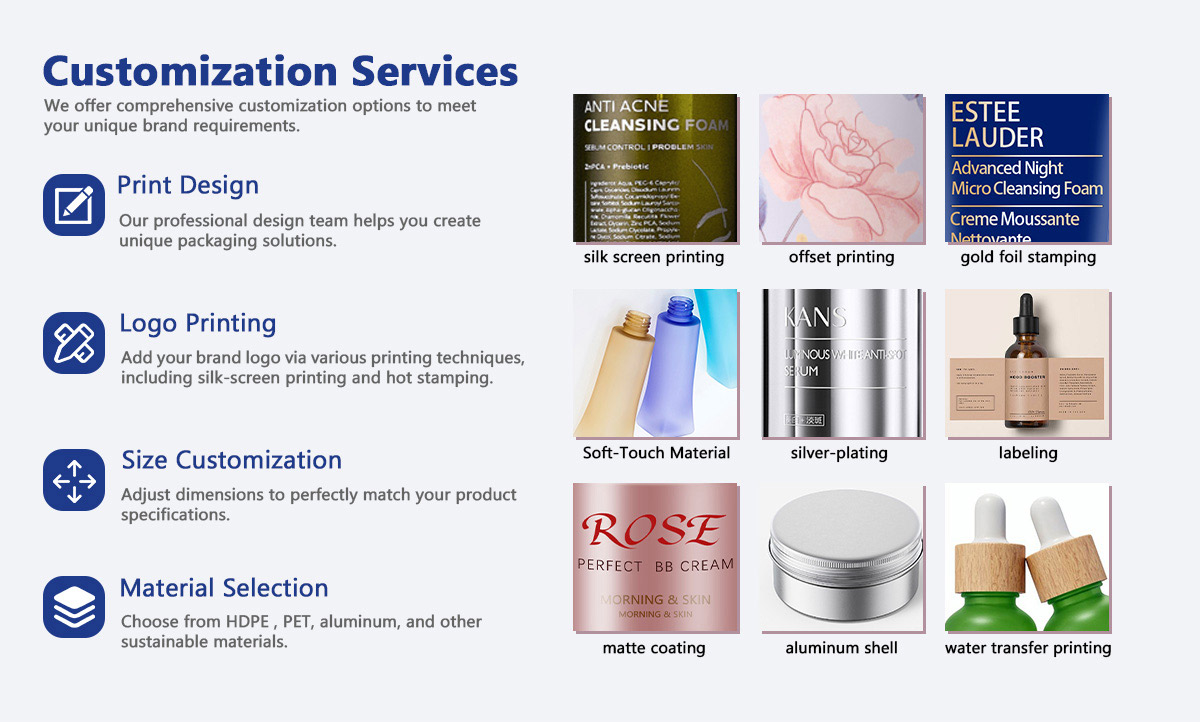
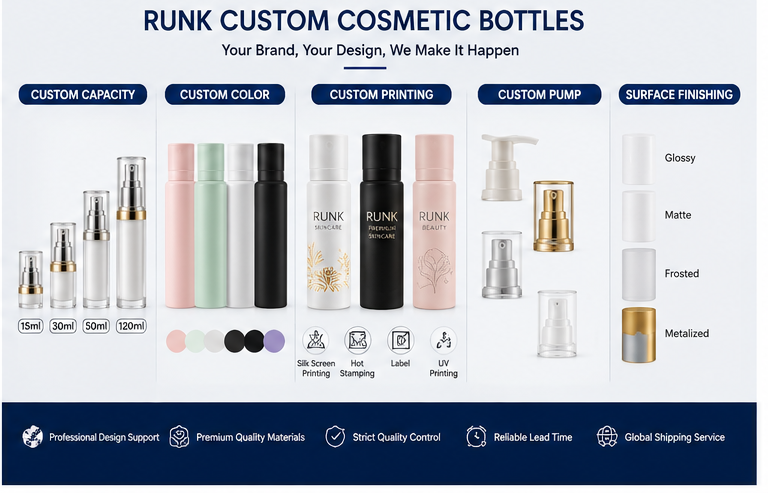
Custom Capacity
Choose suitable bottle capacities according to your formula, product positioning, and consumer usage habits.
Custom Colors
Bottle bodies, pumps, and caps can be customized to match your brand's visual identity.
Custom Printing
Brand logos, product information, patterns, and other graphics can be applied through suitable decoration methods.
Surface Finishing
Different finishing techniques can be selected to create a premium, modern, minimalist, or distinctive appearance.
Different Pump Options
Different dispensing components can be selected according to the formulation, viscosity, dosage, and user experience requirements.
Material Options
Runk can provide different material options according to product requirements, packaging performance, appearance, and sustainability goals.
OEM and ODM Support
From packaging structure selection to appearance customization, Runk can work with brands to develop packaging solutions based on specific project requirements.
Airless Bottle or Lotion Bottle: Which One Is Right for You?
There is no single packaging solution that is perfect for every cosmetic product.
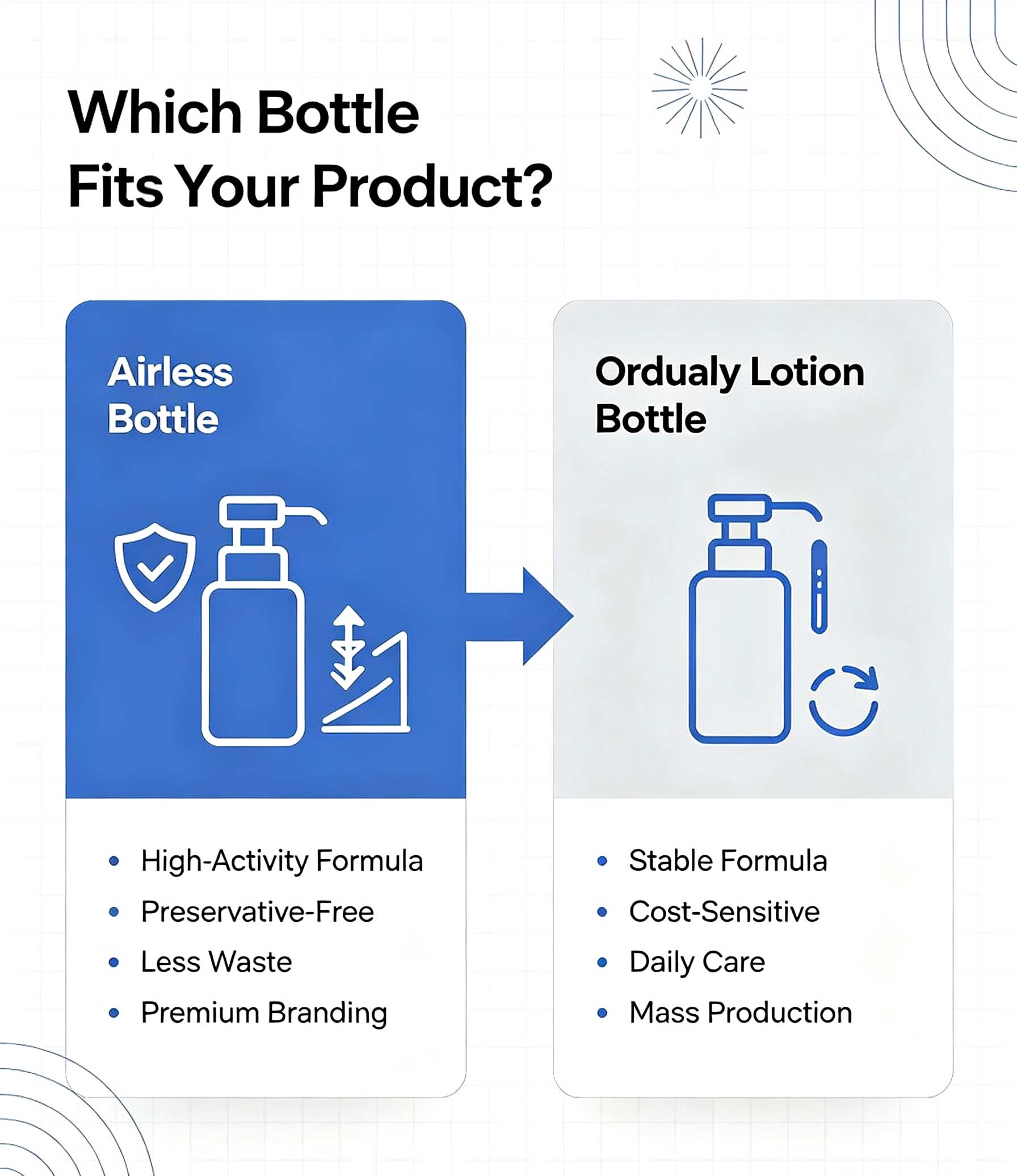
If your priority is product protection, controlled dispensing, premium positioning, and efficient product evacuation, an Airless Bottle may be the better choice.
If your priority is cost efficiency, simple dispensing, broad application, and high-volume production, an Ordinary Lotion Bottle may be more suitable.
The best packaging decision should always consider the formulation, viscosity, compatibility, target market, packaging budget, brand positioning, and consumer experience together.
At Runk, we can help you evaluate different cosmetic packaging options and develop a solution that fits your product requirements.
Looking for a customized Airless Bottle or cosmetic lotion bottle for your next beauty product? Contact Runk to discuss your packaging project.
Frequently Asked Questions About Airless and Lotion Bottles
1. What is the difference between an Airless Bottle and a Lotion Bottle?
The main difference is the dispensing mechanism. Airless Bottles generally use an internal piston or airless dispensing system, while conventional lotion bottles typically use a pump and dip tube.
2. Is an Airless Bottle better for skincare?
Airless Bottles can be an excellent choice for many skincare products, particularly when minimizing direct air exposure and providing controlled dispensing are important.
However, packaging compatibility should always be evaluated according to the specific formulation.
3. Are Airless Bottles completely air-free?
The term "Airless" refers to the dispensing system and its ability to minimize direct air exposure to the product during use. It does not necessarily mean that there is absolutely no air anywhere inside the packaging system.
4. Do Airless Bottles extend product shelf life?
Airless packaging may help reduce exposure to air and external contamination during use, but it does not automatically extend the shelf life of every cosmetic product.
Shelf life depends on the formulation, preservatives, manufacturing process, packaging compatibility, storage conditions, and stability testing.
5. Can thick creams be used in Airless Bottles?
Many creams and thicker skincare formulations can be packaged in Airless Bottles, but compatibility depends on the specific formulation and dispensing system.
A pump performance test should be conducted before mass production.
6. Can shampoo be packaged in an Airless Bottle?
It is possible, but an Airless Bottle is not always necessary for shampoo.
Because shampoo is generally dispensed frequently and is available in many stable formulations, a conventional lotion or shampoo bottle may be a more practical solution.
7. Which bottle is cheaper, Airless or ordinary lotion bottle?
Ordinary Lotion Bottles are generally more economical because their structure is simpler. However, the final price depends on capacity, material, pump, decoration, order quantity, and other customization requirements.
8. Which packaging is more suitable for premium skincare?
Airless Bottles are often a strong choice for premium skincare because they combine a modern appearance with controlled dispensing and reduced direct air exposure.
9. Can I customize an Airless Bottle?
Yes. Depending on the product structure, Airless Bottles can be customized in capacity, color, shape, pump components, printing, hot stamping, coating, and other decorative details.
10. Can I customize an ordinary lotion bottle?
Yes. Conventional lotion bottles can also be highly customized. Brands can select different bottle shapes, capacities, colors, pump heads, caps, printing methods, and surface finishes.
11. How do I know which pump is suitable for my formulation?
The pump should be selected according to factors such as formulation viscosity, required dosage, dispensing direction, product characteristics, and consumer usage habits.
Testing is recommended before finalizing the pump.
12. How much product does one pump dispense?
Pump dosage varies depending on the pump structure and design. Different pumps can provide different output volumes per actuation.
For a specific cosmetic project, the required dosage should be confirmed with the packaging supplier and tested with the actual formulation.
13. Can Airless Bottles be used for serum?
Yes. Airless packaging can be suitable for many serum formulations, especially when controlled dispensing and reduced direct air exposure are desired.
However, the compatibility between the serum formulation and packaging materials should be tested.
14. Are Airless Bottles recyclable?
The recyclability of an Airless Bottle depends on its material composition and the recycling system available in the target market.
Because Airless packaging may contain multiple components, brands should evaluate the complete packaging structure when considering recyclability.
15. What information should I provide when requesting a cosmetic bottle quotation?
To receive a more accurate quotation, brands should ideally provide:
Product type
Required capacity
Target quantity
Preferred bottle material
Pump requirements
Bottle color
Decoration requirements
Packaging application
Target market
Delivery requirements
Providing these details can help the packaging supplier recommend a more suitable solution.
Conclusion
Selecting between an Airless Bottle and an Ordinary Lotion Bottle is ultimately about finding the right balance between product requirements, packaging performance, cost, appearance, and user experience.
Airless packaging is an attractive solution for premium skincare and formulations where controlled dispensing and reduced direct air exposure are important.
Ordinary Lotion Bottles remain an excellent choice for many stable formulations and everyday personal care products because they are practical, familiar, customizable, and cost-effective.
The right packaging is not simply the most advanced option. It is the option that best fits your product.
With flexible customization and cosmetic packaging manufacturing capabilities, Runk can help beauty brands find the right packaging structure and create a distinctive finished product.
Choose the packaging that works for your formula, your brand, and your customers.
Contact : [email protected] | +86-13128608159
Website :
https://www.runkbottle.com | https://www.runkgroup.com | https://runkpackaging.en.alibaba.com
Based in Guangzhou, China – serving beauty brands worldwide.
Table of Contents
- Airless Bottle VS Ordinary Lotion Bottle: Which One Fits Your Product?
- What Is an Airless Bottle?
- What Is an Ordinary Lotion Bottle?
- Airless Bottle VS Ordinary Lotion Bottle: 8 Key Differences
- 1. Dispensing Mechanism
- 2. Product Protection
- 3. Product Evacuation
- 4. Hygiene and User Experience
- 5. Formula Viscosity
- 6. Packaging Cost
- 7. Brand Positioning
- 8. Sustainability and Material Selection
- Airless Bottle VS Ordinary Lotion Bottle Comparison
- When Should You Choose an Airless Bottle?
- When Should You Choose an Ordinary Lotion Bottle?
- How to Choose the Right Cosmetic Bottle for Your Product
- Product Formula
- Viscosity
- Product Sensitivity
- Target Market
- Budget
- Brand Image
- Required Capacity
- Custom Cosmetic Bottle Solutions From Runk
- Airless Bottle or Lotion Bottle: Which One Is Right for You?
- Frequently Asked Questions About Airless and Lotion Bottles
- 1. What is the difference between an Airless Bottle and a Lotion Bottle?
- 2. Is an Airless Bottle better for skincare?
- 3. Are Airless Bottles completely air-free?
- 4. Do Airless Bottles extend product shelf life?
- 5. Can thick creams be used in Airless Bottles?
- 6. Can shampoo be packaged in an Airless Bottle?
- 7. Which bottle is cheaper, Airless or ordinary lotion bottle?
- 8. Which packaging is more suitable for premium skincare?
- 9. Can I customize an Airless Bottle?
- 10. Can I customize an ordinary lotion bottle?
- 11. How do I know which pump is suitable for my formulation?
- 12. How much product does one pump dispense?
- 13. Can Airless Bottles be used for serum?
- 14. Are Airless Bottles recyclable?
- 15. What information should I provide when requesting a cosmetic bottle quotation?
- Conclusion