EN
EN


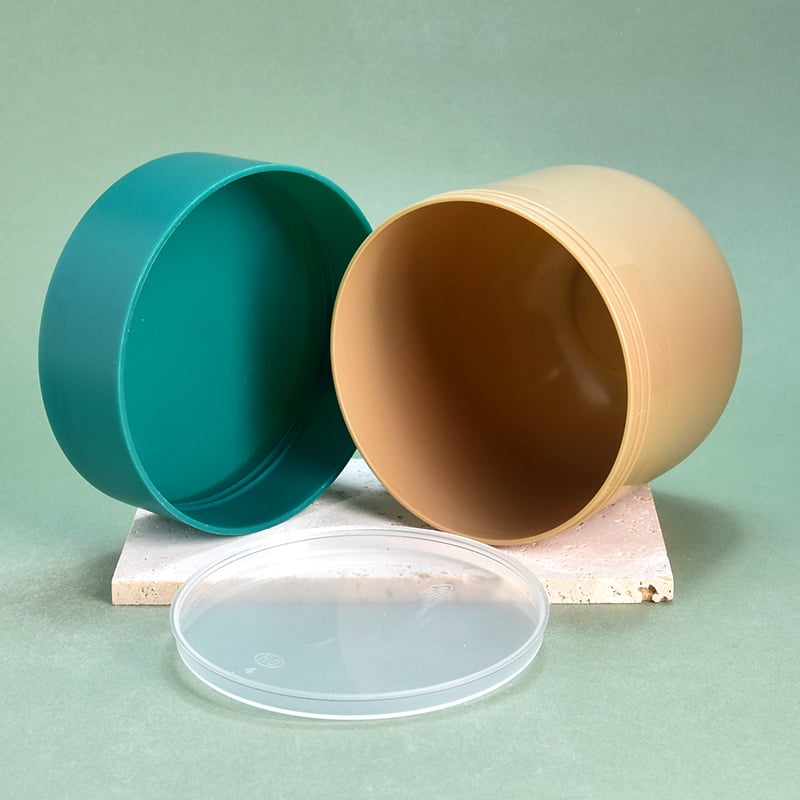
Structural Durability: Engineering Reinforced Thread Jars for Heavy-Duty Use
Thread Design, Cap Fit, and Torque Performance in High-Load Applications
Reinforced thread jars for large-capacity body creams require precision-engineered threads that resist loosening under vertical stacking, vibration, and repeated handling. Multi-start threads accelerate capping but demand deeper engagement—typically 2.5 full turns—to distribute clamping force evenly across the neck. A 2023 study by the Packaging Dynamics Lab found that double-thread profiles retained 94% of applied torque after a 72-hour vibration test (ASTM D4169 truck-level PSD), outperforming standard single-thread designs (79%). Cap fit is equally critical: a diametral interference of 0.15–0.25 mm between cap skirt and jar body prevents lateral shift—the primary trigger for back-off. Torque performance depends on neck rigidity; reinforced PET neck walls resist ovalization during high-force capping. For PET jars in the 100–500 mL range, the safe application torque window is 2.0–2.5 N·m. Exceeding 3.0 N·m cracks the thread root in 68% of samples (ContainerTech Labs, 2022); values below 1.5 N·m triple leakage risk. An aggressive thread flank angle (≥60°) combined with an annular cap bead creates a self-locking effect that maintains seal integrity under 45-kg stacking loads.
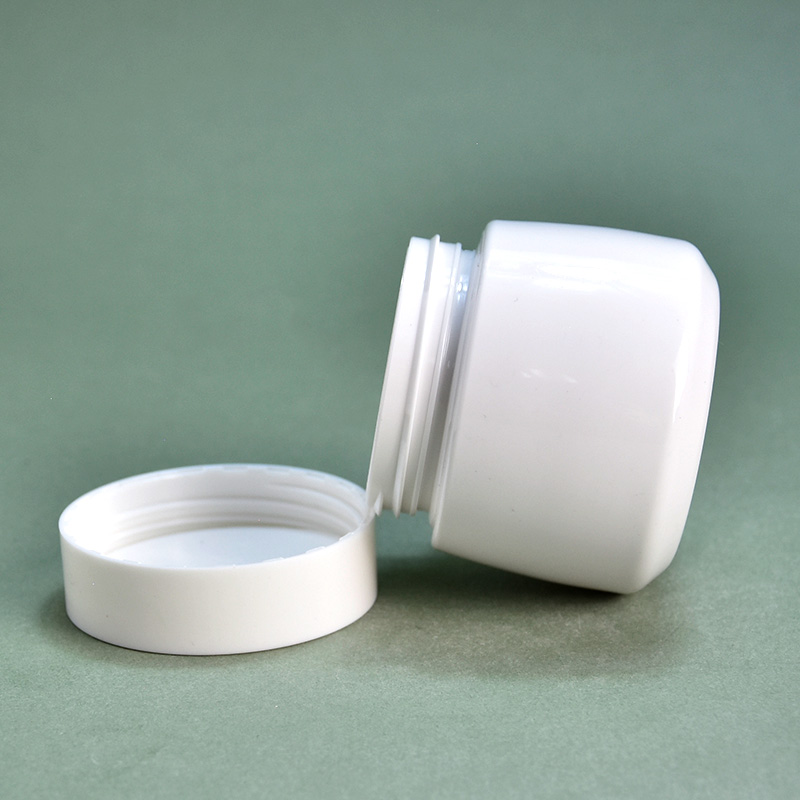
Neck Finish Standards (70/450, 86/460, 89/400) and Sealing Integrity Validation
Neck finish codes—including 70/450, 86/460, and 89/400—define the mechanical interface between jar and cap, directly governing load-bearing capacity and sealing reliability. While 70/450 suits lighter formats, reinforced large-capacity jars benefit from the larger-diameter 86/460 and 89/400 profiles, which increase neck cross-sectional area by 24% and 31%, respectively (PackTest Intl, 2022). The 89/400 finish, especially when paired with a buttress-style thread, withstands 35% higher lateral load before cap disengagement than the 70/450 benchmark. Sealing integrity is validated through drop tests from 1.2 m onto concrete (ASTM D5276) and thermal cycling from –20°C to 50°C. Jars with an 86/460 neck and induction-sealed liner achieved a 99.4% pass rate across 500 samples (Seal Integrity Consortium, 2023). The 400-series continuous threads excel in repeated opening/closing durability, while deeper 450/460 buttress threads deliver superior axial strength for stacking. When combined with localized wall-thickness reinforcement at the neck, these standards ensure hermetic integrity—even with dense, high-viscosity creams subjected to e-commerce logistics and consumer handling.
Large-Capacity Optimization: Balancing Volume, Stability, and User Experience
Capacity Range (100–500 mL) and Its Impact on Wall Thickness & Bottom Reinforcement
As volume increases from 100 mL to 500 mL, structural demands intensify: greater mass amplifies top-load pressure and sidewall stress. In reinforced thread jars, wall thickness scales accordingly—from 2.0 mm at 100 mL to 2.8–3.2 mm at 500 mL. Overly thin walls risk buckling during capping or transit; excessive thickness wastes material and inflates cost. Bottom reinforcement is equally essential: an unreinforced flat base can bow under 500 mL of dense cream, causing instability or stress fractures. A recessed base ring or radial ribbing redistributes load, reducing stress concentration by up to 35% (Plastics Engineering Report, 2023). Jars above 300 mL often integrate a thicker central push-up and radial ribs—boosting drop-test survival by 28% versus flat-bottom benchmarks (Industry Drop-Test Benchmarking, 2022). These targeted reinforcements preserve container integrity through e-commerce fulfillment and daily use, safeguarding both product performance and brand perception.
Height-to-Diameter Ratio: Scoop Access, Shelf Stability, and Stackability Trade-offs
| Height‑to‑Diameter Ratio | Scoop Access | Shelf Stability | Stackability | Typical Use Case (100–500 mL) |
|---|---|---|---|---|
| 0.5:1 (low, wide) | Easy, full‑hand entry | Excellent (low center of gravity) | Poor (wide bases nest poorly) | 500 mL tubs, daily‑use jars |
| 1:1 (balanced) | Good, standard scoop reach | Very good | Moderate (stable when stacked with spacers) | 300 mL jars, retail shelves |
| 1.5:1 (tall, narrow) | Difficult, requires angled scoop | Reduced (higher tip risk) | Excellent (narrow, uniform footprint) | 150 mL travel jars, limited shelf depth |
The height-to-diameter ratio balances user convenience, physical stability, and supply-chain efficiency. Low, wide jars (0.5:1) offer optimal scoop access and shelf stability but consume disproportionate retail space and stack poorly—increasing warehousing costs. Tall, narrow designs (1.5:1) maximize vertical stacking and floor-space efficiency but compromise usability, often requiring awkward tilting or specialized tools. The 1:1 ratio delivers the strongest compromise for 300–500 mL heavy-duty jars—maintaining low center-of-gravity stability while enabling secure stacking via shallow lid indentations. For reinforced thread systems, neck finish selection aligns naturally with proportion: wider openings (e.g., 89/400) suit low-ratio bodies, while narrower necks support taller profiles without sacrificing seal integrity. Strategic alignment of geometry and finish ensures the jar feels stable on the vanity, accommodates intuitive product access, and survives end-to-end distribution.
Leakage Prevention: Dual-Layer Sealing Systems for High-Viscosity Body Creams
Liner and Gasket Compatibility with Dense Creams Under Thermal Cycling
Dense body creams place exceptional demands on sealing systems—especially during thermal cycling. A dual-layer approach—combining a pressure-sensitive inner liner with a resilient outer gasket—is essential for long-term leak resistance. The liner must resist absorption and swelling from emollient-rich formulations (e.g., shea butter, squalane), while the gasket—typically EPDM or medical-grade silicone—must retain compression set elasticity across temperature swings from –10°C to 45°C. Incompatible pairings cause delamination or permanent gasket deformation, creating micro-gaps that permit seepage. Validated under simulated shipping conditions—including cyclic thermal chambers—matched liner–gasket systems maintain hermetic integrity over full shelf life, protecting both product efficacy and consumer trust.
Material Performance: PET vs. Glass for Heavy-Duty Large-Capacity Jars
Selecting the right material for heavy-duty, large-capacity jars directly affects structural resilience, logistics efficiency, and user perception. PET (Polyethylene Terephthalate) and glass represent fundamentally different engineering trade-offs—particularly under the mechanical stresses of reinforced thread closures and high-viscosity payloads.
PET excels in impact resistance and weight reduction. Advanced Injection Stretch Blow Molding (ISBM) yields shatterproof containers ideal for bathroom environments where accidental drops are common. Glass delivers premium sensory cues—a substantial, cool weight—and superior oxygen and moisture barrier properties. Yet its fragility necessitates thicker walls, increasing weight, shipping cost, and carbon intensity.
| Performance Metric | PET | Glass |
|---|---|---|
| Weight (Typical 300 mL jar) | Lightweight, reduces shipping fuel | Significantly heavier, increasing CO₂ emissions |
| Impact Resistance | High; nearly unbreakable with ISBM | Low; fragile, prone to shattering |
| Carbon Footprint (per bottle) | ~0.17 kg GHG (Packaging Digest 2023) | ~0.37 kg GHG (Packaging Digest 2023) |
| Water Usage (per bottle) | Higher (3.16 L) | Lower (1.87 L) |
| Thermal Shock Resistance | Good; can deform under extreme heat | Poor; risks cracking with rapid temperature changes |
The final choice reflects strategic priorities: luxury positioning may justify glass’s operational constraints, while direct-to-consumer brands prioritize PET’s durability, lower emissions, and supply-chain resilience. For large-capacity jars engineered for daily, high-frequency use, material selection ultimately hinges on which substrate best ensures the container arrives intact—and remains functional—on the bathroom counter.
FAQs
Why are reinforced threads important for heavy-duty jars?
Reinforced threads resist loosening under high-stress conditions like vertical stacking and vibration, helping jars maintain their seal and torque for extended periods of use.
What factors improve sealing integrity for large-capacity jars?
Sealing integrity improves with compatible neck finish standards, double-layer sealing systems (liner and gasket pairings), and advanced testing like drop and thermal cycling. It also depends on neck rigidity and proper torque application.
Which material is better for reinforced jars, PET or glass?
PET offers superior impact resistance, reduced weight, and lower carbon emissions, making it ideal for heavy-duty applications. Glass provides a premium feel but is heavier, less durable, and has a higher environmental impact.
What height-to-diameter ratio is ideal for large-capacity jars?
The 1:1 height-to-diameter ratio offers the best balance of scoop access, shelf stability, and stackability for jars between 300 mL to 500 mL.
How do neck finish codes like 89/400 and 70/450 differ?
Neck finish codes define the jar and cap interface. Larger diameters like 89/400 provide higher load capacity and better sealing performance than smaller finishes like 70/450, especially for reinforced designs.
Table of Contents
- Structural Durability: Engineering Reinforced Thread Jars for Heavy-Duty Use
- Large-Capacity Optimization: Balancing Volume, Stability, and User Experience
- Leakage Prevention: Dual-Layer Sealing Systems for High-Viscosity Body Creams
- Material Performance: PET vs. Glass for Heavy-Duty Large-Capacity Jars
- FAQs